NICOLE, as the leading European network on sustainable land management of industrial sites, hosted its traditional Fall Workshop this year in Budapest. The primary objective of the event was to raise awareness and promote the dissemination and exchange of best practices in sustainable remediation, supporting applied research and knowledge transfer among its members, and actively monitoring and backing regulatory developments at the EU and member state levels.
NICOLE workshops are playing an essential role in EU legislation and project development among NICOLE members. The Fall Workshop was carried out in cooperation with the Hungarian Association of Environmental Enterprises. Therefore, one of the professional focus points was the state and results of remediation in Hungary, as well as the problem of funding remediation projects at the international level, and innovation in fields such as sampling, analysis, decision-making, or the remediation of special contaminants.
On the first day, participants heard presentations on the current state and results of the legal environment and remediation actions in Hungary by Dr Anikó Raisz, State Secretary for Environmental Policy at the Ministry of Energy, Gabriella Gyetvai (TRENECON Ltd.), and Gábor Galgóczi (Nitrokémia cPlc.). There were presentations about good examples for projects in Hungary, like the implementation of a GCW (groundwater circulation well) remedial system under complex geological conditions (by Melinda Wieser, WSP) or in situ- and ex situ treatment of a contaminated sediment with combined ISCO-ISS (in-situ chemical oxidation and in situ solidification and stabilisation) and Terramend technology (Imre Szabó & Josephine Moline, BGT Hungaria Kft. & Evonik).
An emphasised topic was also the challenges of preparing for remediation in countries facing difficult circumstances, for example the war-affected Ukraine. Besides the introduction of fundraising activities, it was thought-provoking to hear about the difficulties of soil sampling under war conditions, how to prepare a country for post-war remediation, or what side effects may result from demolishing a nearly 70-year-old water reservoir covering more than 2,000 km². The speaker, Pier Carlo Sandei (UNEP), came from Kyiv directly. The other speaker was Johan De Fraye (NICOLE Foundation). However, there was a presentation on the collaborative handling of POP-polluted legacy hotspots in Bosnia and Herzegovina, which has overlapping (and sometimes disconnected, not communicating) public administration regimes (Ilona van der Kroef, TAUW).
Besides these, other interesting case studies were introduced, such as AI-powered environmental data management (with EQuIS software, by Dan Alexander from EarthSoft), or discovering a previously unidentified, tyre-derived (!) toxin through observing catastrophic mortality of a specific salmon species under particular conditions in the nature (by Ken Scally, Normec DETS & LATIS Scientific). There was also an innovative, data-driven approach for monitoring and quantifying the remediation process, involving the analysis of quantities of different natural carbon isotopes in carbohydrates and identification of the bacterial genome, using molecular biological tools (Kevin Kuntze, Isodetect GmbH).
Meanwhile, between the speeches, a contest for the NICOLE Innovation Award 2025 took place. The winner was Haemers Technologies’ Krysalis Innovation for delivering an innovative PFAS soil remediation technology.
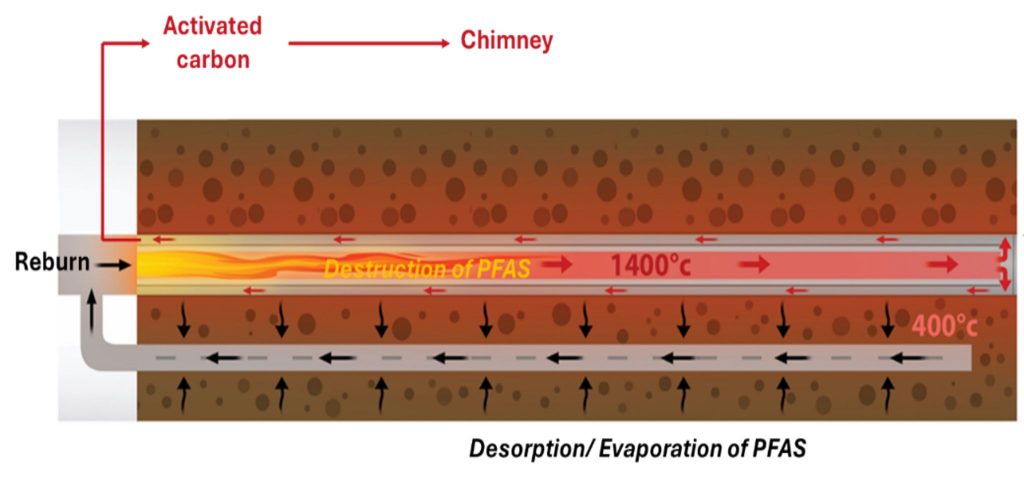
The second day was a perfect continuation of the detailed discussion of remediation methods, beginning with the technical and economical details of the Innovation Award winner from the previous day, “Containerized Thermal Treatment System for the Destruction of PFAS in Contaminated Soils” (by Mael Makoudi, Haemers Technologies).
Listening to the following presentation about the dynamic challenges and opportunities to remediate primary and emerged contaminants (by Glauco Giordano, Jacobs) one got to see case studies about different contaminated sites and their method of assessment. Based on these assessments Glauco also summarized the importance of integrated remediation strategies, adaptive collaborative frameworks, research and community engagement to get better results and more success through site investigation and remediation techniques.
After that the participants could hear a talk about testing nature based, microbial degradation and phytoremediation techniques in lab-, green house- and pilot experiments to remove PFAS, in order to test, how effective they are. Different sorbents (zeolite, activated carbon, bentonite) were tested with different types of plants such as birch, willow, sunflower and reed, with different removal rate. (by Tom Bosma, Deltares)
Presentation on innovative lab experiments to better understand back-diffusion during groundwater remediation demonstrated and raised a lively discussion on the relevance of the monitoring of this mechanism. Tamás Madarász and his fellow professionals observed the behaviour of oil-based phases in a diffusion cell, using fluorescent tracing in a laboratory test to understand back-diffusion better.
(by Tamás Madarász, University of Miskolc, Institute of Water Resources and Environmental Management)
Josephine Molin by Evonik introduced how biogeochemical reduction (BGCR) processes gaining ground in in situ chemical reduction (ISCR) and enhanced reductive dechlorination (ERD). Bench, Pilot and Full-scale application conducted the firm aimed to demonstrate how biologically generated minerals degrade CVOCs and equester toxic metals such as arsenic, chromium and copper. Results shown, that Evonik products, such as Geoform enhanced the degradation of the CVOCs.
Last, but not least Fermentia Ltd. shared their natural, eco-friendly way of remediating short-chain hydrocarbon contaminants by organohalide-respiring microorganisms, emphasising the importance of microbial inoculants in soil improvement. This type of in-situ depollution method differs from conventional chemical or physical expedients and brought up some questions about time claiming and special microbiological arrangements.
(by Zsuzsanna Nagymáté, Fermentia Ltd.)
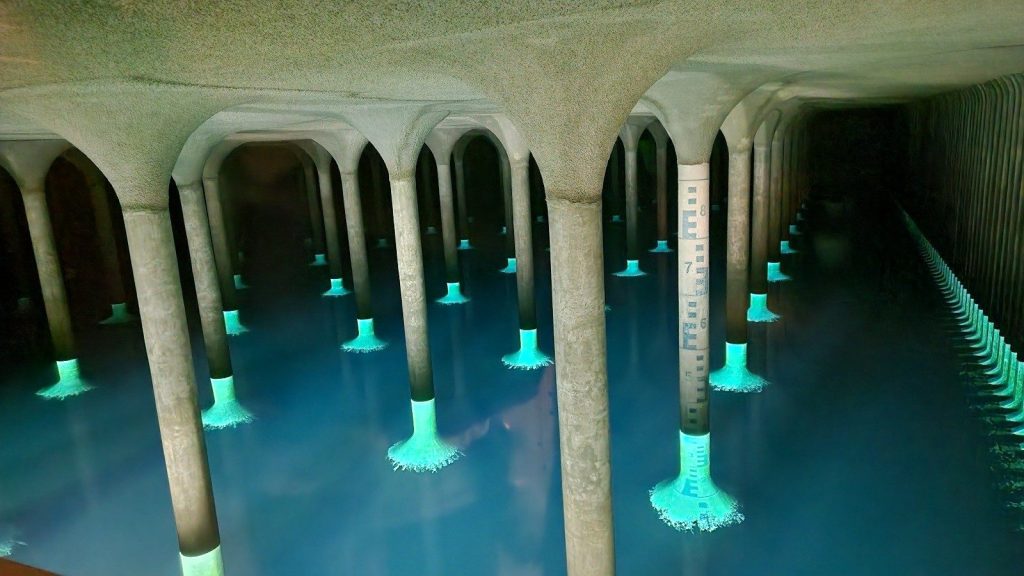
At the end of the workshop, there was a site visit to the József Gruber Water Basin, which is the largest water reservoir in Budapest, situated in the Gellért hill. It’s two basins has a surface area of 5,000 m2, a capacity of 40,000 cubic metres, and a slab structure supported by 106 spectacular pillars (each). The construction took place between 1974 and 1980, and since then it is a spectacular and unique place to visit among the Budapest sightseeing spots.
Our Association, HAEE, was represented on the organising committee of NICOLE’s Fall Workshop in Budapest by its chairman, Dr Csaba Ágoston, and Gergely Tóth, head of the Damage Prevention and Mitigation Working Group and member of the Board. Our participation in the organisation provided an opportunity to focus on the situation of domestic remediation and related region-specific issues. We would like to congratulate the Hungarian speakers on their participation in this prestigious event and on representing our country and our association.
The professional work continues in the remediation working group and at our ENVIRONTEC international trade fair in October 2026.